


 Back
Back- Industrial Bag Sealers
- Vertical Form Fill & Seal (VFFS)
- Low Acid Aseptic
- High Acid Aseptic
- Retort
- Extended Shelf Life (ESL)
- Ultra Clean
- Hot Fill
- Back
- EZHANDLE™
- NEXTPAK™
- BLOCKBAG™
- Stock Bags
- Rollstock
- Lidstock
- Pouches
- Bags
- FIBCs & Liners
- Degassing Valves
- Dispensing Taps & Fitments
From Rigid to Flexible: How Modern Packaging Improves Performance Across Industries




Product packaging serves as more than a vessel for your goods—it’s a critical business asset that influences brand perception, operational efficiency, and environmental impact. While aesthetics matter, the true value of packaging is in how well it protects products, extends shelf life, optimizes logistics, minimizes waste, and supports sustainability initiatives throughout the supply chain.
For decades, industries have defaulted to rigid packaging solutions such as metal cans, plastic canisters, glass bottles, plastic/fiber drums. But as supply chains grow more complex and sustainability expectations intensify, these traditional formats are showing their limitations. Whether you’re roasting coffee, producing industrial resins, manufacturing pet food, or supplying ingredients for the food industry, flexible packaging alternatives are delivering measurable advantages in durability, preservation, efficiency, resource optimization, and environmental performance. All of these factors compound over time and can significantly impact your bottom line.
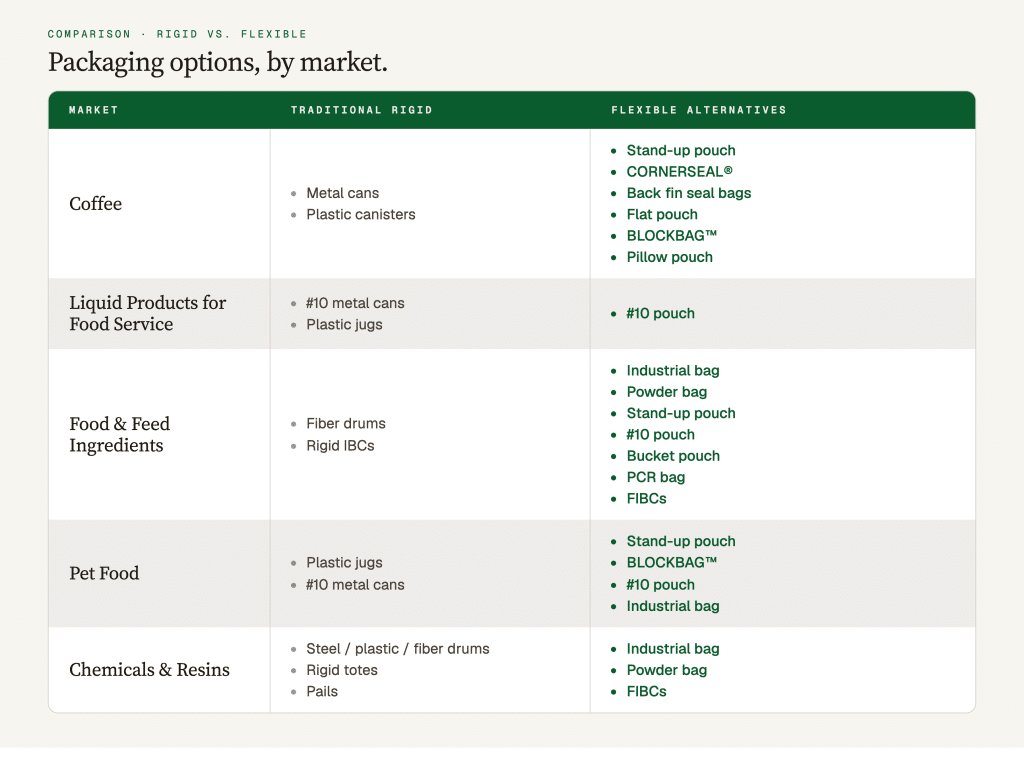
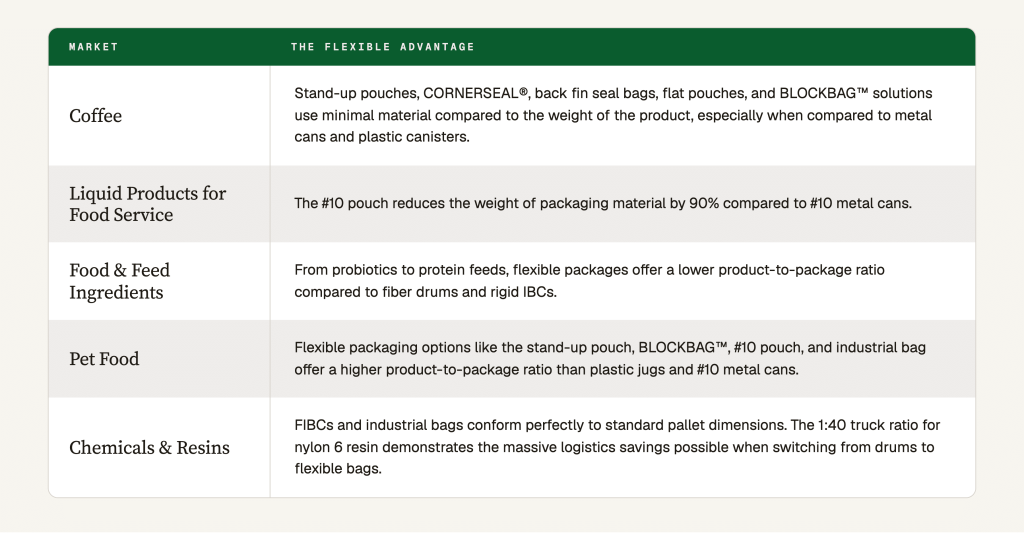
Understanding Your Options: Rigid vs. Flexible by Market
Before diving into the advantages, let’s look at what the shift from rigid to flexible packaging looks like across different industries.
5 Key Advantages of Flexible Over Rigid Packaging
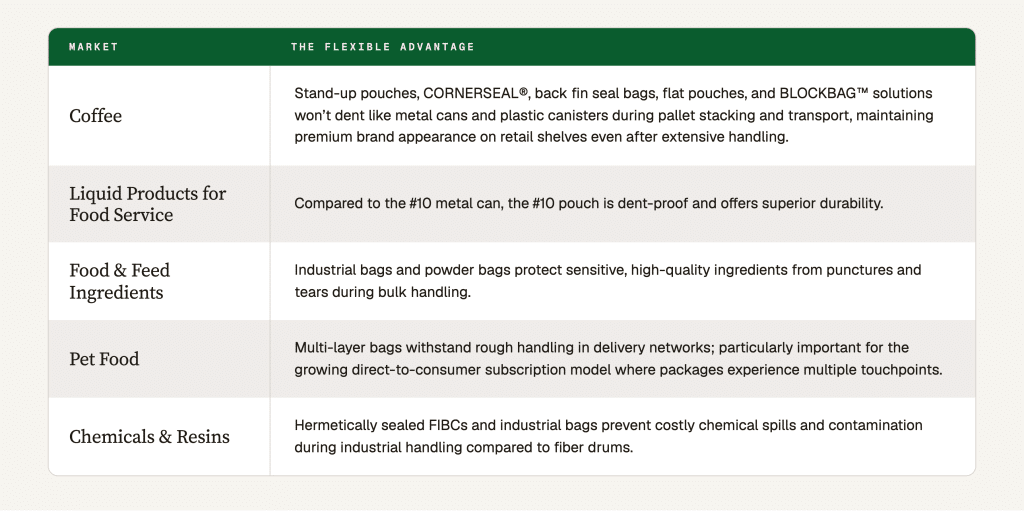
1. Enhanced Durability and Impact Resistance
Shipping damage is a persistent challenge across supply chains. According to Packaging Digest, as much as 11% of unit loads arriving at a distribution center have some level of damage. When packaging fails, it doesn’t just compromise the product inside. Carriers may reject entire freight loads even when only a handful of units show damage, leading to abandoned shipments and emergency replacement orders.
The costs of damaged packaging add up quickly, both financially and logistically. Beyond replacing the product and shipping materials, companies must coordinate rapid turnaround times for replacement shipments. These seemingly small product losses can accumulate into substantial unnecessary expenses over time.
Unlike breakable glass or dent-prone cans, flexible packaging is designed to better absorb impact during transportation. Flexible packaging is also customizable, enabling manufacturers to incorporate appropriate layers of protection depending on the product. Whether it’s a stand-up pouch for retail coffee, a #10 pouch for food service products, or heavy-duty FIBCs for industrial chemicals, flexible packaging withstands the rigors of modern supply chains while keeping products intact from manufacturing facility to end consumer. Lower damage rates mean fewer claims, returns, and costly reshipping scenarios—protecting both your products and your profit margins.
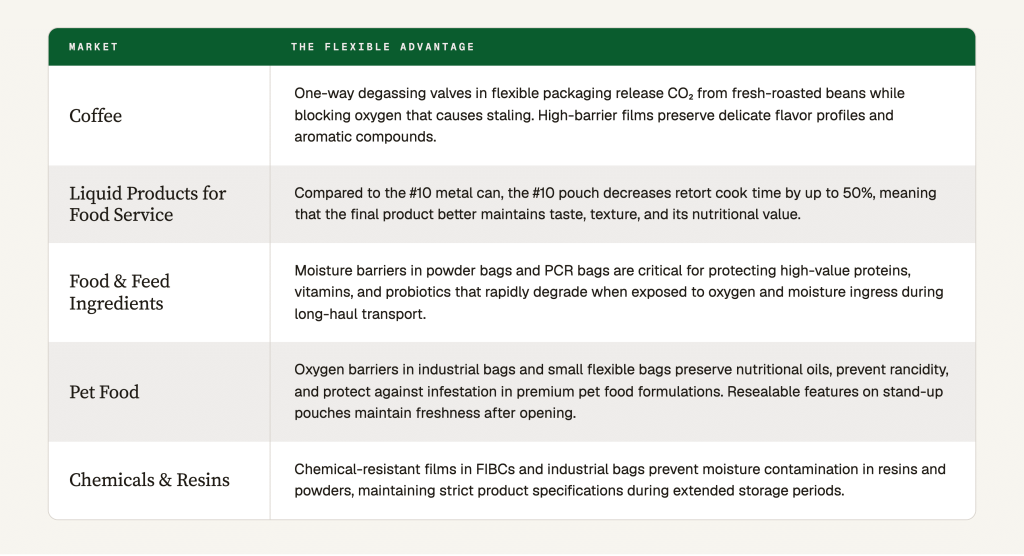
2. Extended Shelf Life and Superior Product Preservation
Product protection goes beyond preventing physical damage during transport. Across North America, most freight travels via trucks over long highway stretches. Unless products require refrigeration or freezing, they move without any temperature control. This means products face environmental temperature swings and climate changes, making them vulnerable to dehydration, moisture problems, and oxidation, sometimes for hours or even days, before reaching customers. International shipping increases these risks even more, particularly for high-value or sensitive ingredients.
Flexible packaging options like powder bags, stand-up pouches, and BLOCKBAG™ create airtight seals that shield products from environmental elements including sunlight, temperature changes, and moisture. This protection helps extend the shelf life of perishable products. You can also customize flexible packaging with features like one-way degassing valves for enhanced preservation. These valves work by allowing gases emitted from the product or air to escape while preventing air from flowing back in.
The high-barrier films and secure seals in flexible packaging work together to prevent spoilage, which reduces costly claims and returns. At the same time, this protection cuts down on wasted product, supporting sustainability initiatives. Better preservation translates to longer shelf life, products that arrive fresher to consumers, and less waste throughout your supply chain.
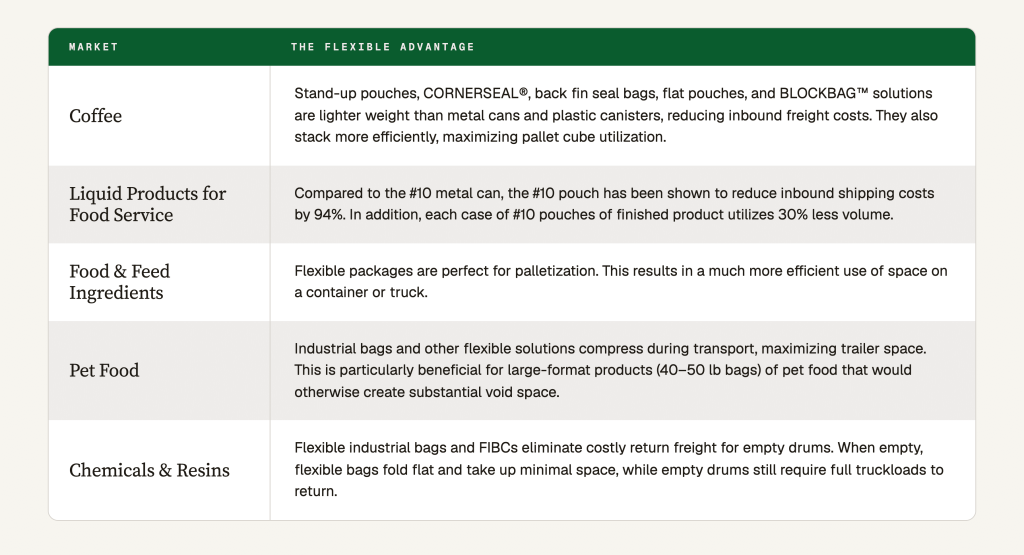
3. Maximized Shipping and Storage Space
Shipping costs are inevitable in business, but efficiency makes the difference in keeping them under control. Rigid packaging with irregular shapes leaves empty, unused space in trucks, shipping containers, warehouses, and distribution centers. This wasted space means you need more truckloads and more real estate, driving up costs unnecessarily.
Flexible packaging enables compact, stable palletization that minimizes empty space between and inside packages during transport. With less wasted space, you can fit more products in a single truckload. For example, one truck of flexible bags can package the same amount of nylon 6 resin as 40 trucks of 30-gallon drums. That’s not a small improvement—it’s a dramatic shift in shipping efficiency that creates immediate cost savings.
Fewer truckloads mean your operations use less water, energy, and fuel while producing fewer emissions, shrinking your overall carbon footprint. Flexible packaging also performs better when shipping rates are based on dimensional weight, helping reduce freight charges. This iImproved space utilization delivers lower freight costs and a smaller carbon footprint across your distribution network.
4. Higher Product-to-Package Ratio
Traditional rigid packaging often uses a lot of packaging material relative to the actual product inside. Low ratios like these point to excess resource consumption and unnecessary waste. Heavy packaging also increases your freight costs at every stage of the supply chain and creates more material to dispose of at the end.
Flexible packaging delivers a much higher product-to-package ratio. A higher ratio means more product compared to packaging material, which translates to less resource use and less total waste. According to the Flexible Packaging Association (FPA), a single-serve liquid pouch achieves a 97:3 product-to-package ratio.
This higher ratio also means lighter weight, which can significantly reduce your inbound freight costs. Flexible packaging also lets you stack products more compactly, eliminate empty space, fit more product per shipment, and reduce overall weight—optimizing your logistics costs in both directions.
5. Comprehensive Sustainability Benefits
Demand for sustainable packaging is growing from both corporations and consumers, reshaping standards across all industries. Traditional rigid packaging comes with a heavy environmental cost: high energy use during production, significant greenhouse gas emissions, substantial landfill waste, and resource-intensive transportation. Companies everywhere are looking for packaging that reduces environmental impact without sacrificing performance.
Flexible packaging stands out as an exceptionally efficient solution when you look at its total lifecycle, even as a single-use plastic compared to recyclable options. Just in the shipping phase alone, flexible packaging requires fewer trucks and pallets for transport, which means less energy use, lower fossil fuel consumption, and reduced environmental pollution. These benefits come from flexible packaging’s lighter weight, superior product-to-package ratio, and better palletization. The durability advantages also support sustainability by preventing product damage and spoilage, which reduces waste and saves the resources that went into making those products in the first place.
Production impacts are equally significant. Multi-layer flexible packaging uses fewer resources and generates less waste and emissions compared to rigid options. Beverage pouches illustrate this perfectly—they use approximately 90% less energy to produce and emit about 90% less greenhouse gas than glass bottles, dramatically reducing the total carbon footprint. The #10 pouch shows similar advantages compared to the #10 can: it cuts landfill waste in half, reduces greenhouse gas emissions by 62%, and lowers BTU consumption by 71%. From production through transportation to disposal, flexible packaging delivers better environmental performance while helping companies meet their sustainability goals and improve operational efficiency.
Making the Switch: What to Consider
Transitioning from rigid to flexible packaging is a strategic decision that can deliver significant benefits, but it’s important to approach the change thoughtfully. Here are key factors to consider as you evaluate flexible packaging for your operations:
- Product characteristics: Is your product a powder, liquid, granular material, or something else? Is it temperature-sensitive or prone to oxidation?
- Current pain points: Are you experiencing high damage rates, excessive shipping costs, or shelf life issues with current packaging?
- Regulatory requirements: What industry-specific regulations apply to your packaging (food safety, chemical handling, etc.)?
- Volume and operations: What are your production volumes, and how will flexible packaging integrate with your current filling and sealing equipment?
- Custom solutions: Every product and application is unique. The right flexible packaging partner can develop customized solutions that address your specific challenges and grow with your business.
- Equipment guidance: Transitioning to flexible packaging may require new filling and sealing equipment. An experienced partner can guide you through these decisions.
Streamline Your Operations with Flexible Packaging
The shift from rigid to flexible isn’t just a packaging change—it’s a strategic business decision that impacts your bottom line, your environmental footprint, and your brand reputation.
If you’re considering making the switch or want to learn more about how flexible packaging can positively impact your business, connect with our flexible packaging experts for a one-on-one consultation. We can help you overcome your packaging and shipping challenges and identify the optimal solutions for your specific applications.

Topics: Flexible Packaging, Sustainability
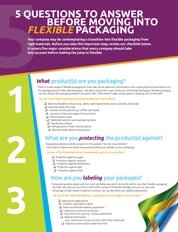
Moving from rigid to flexible packaging?

Subscribe to Email Updates
Read Fres-co's Recent Insights
Fres-co Returns to PACK EXPO 2026: Flexible Packaging Solutions for Every Industry
Ensuring Food Safety: The Ultimate Guide to Liquid Packaging Machines
From Rigid to Flexible: How Modern Packaging Improves Performance Across Industries